I spent the last weekend turning one economics talk into an interactive map of the AI change curve. Here is what it taught me, and what you can play with yourself.
Ask how powerful AI is and you will get a fight. Ask how fast that power turns into growth and you get something more useful: a number, a shape, and a surprisingly calm answer.
The answer I kept landing on is this. The upside is real but slow. The downside is fast and fragile. And the whole thing turns on one humble idea: weak links.
So I built howfastis.ai, a living, interactive explainer that tries to show you where we actually are on the curve, instead of telling you how to feel about it.
The one idea: weak links
A chain is only as strong as its weakest link.
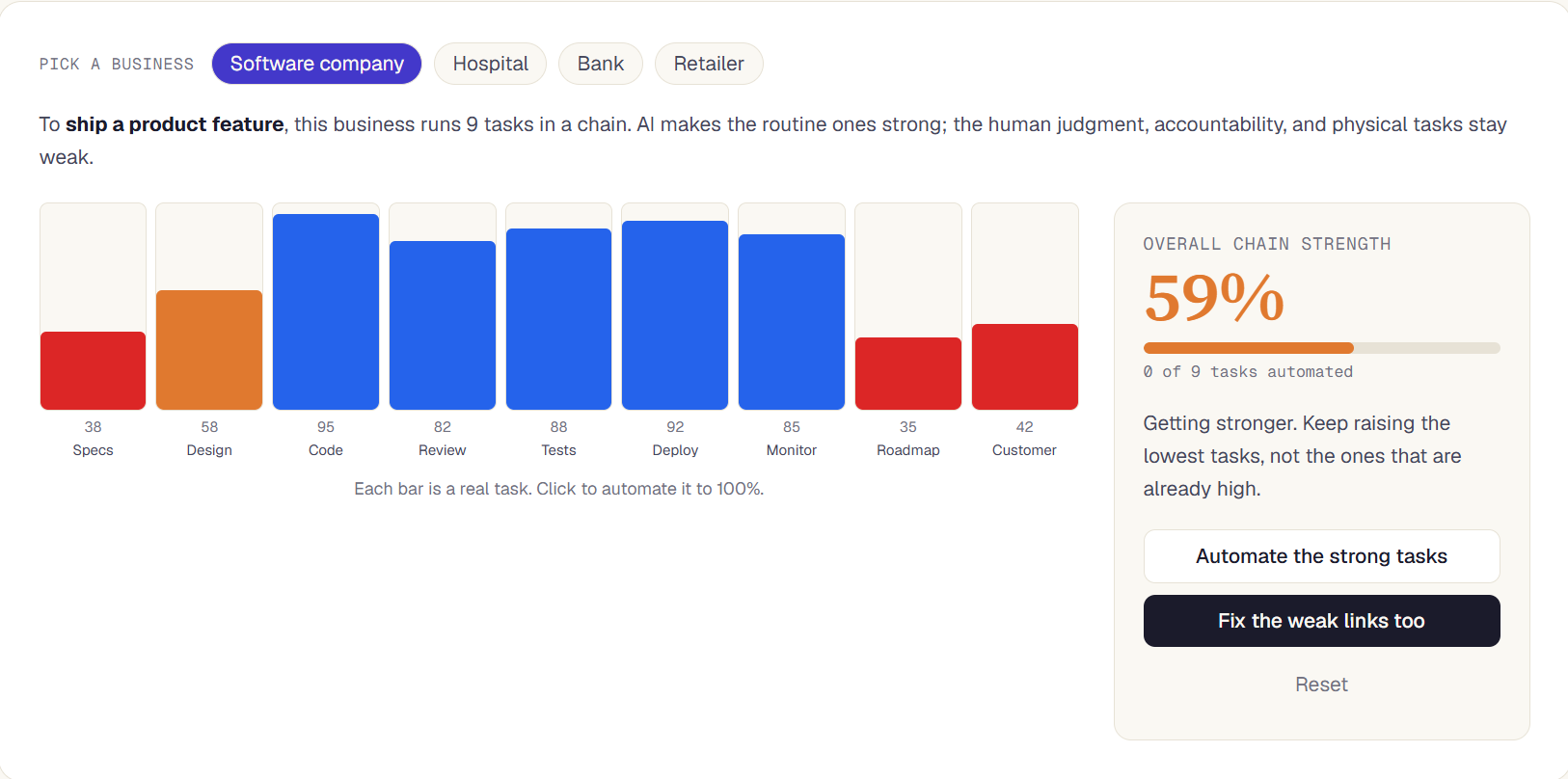
Most real work is a chain. To ship an iPhone you design it, source the parts, hold manufacturing to absurd tolerances, deliver it, market it, support it. Miss one link and the value leaks out. A business is a chain of tasks, and the weakest task sets the result.
Here is the uncomfortable corollary. If a chain has 20 links and you make 17 of them incredibly strong, the chain barely improves. The three weakest links still decide how much weight it holds.
On the site you can feel this directly. Pick a business, a software company or a hospital, automate every task AI is already good at, and watch the overall strength refuse to budge. The bars you automate light up. The result hardly moves. That is the whole thesis in one widget.
The puzzle that should bother you
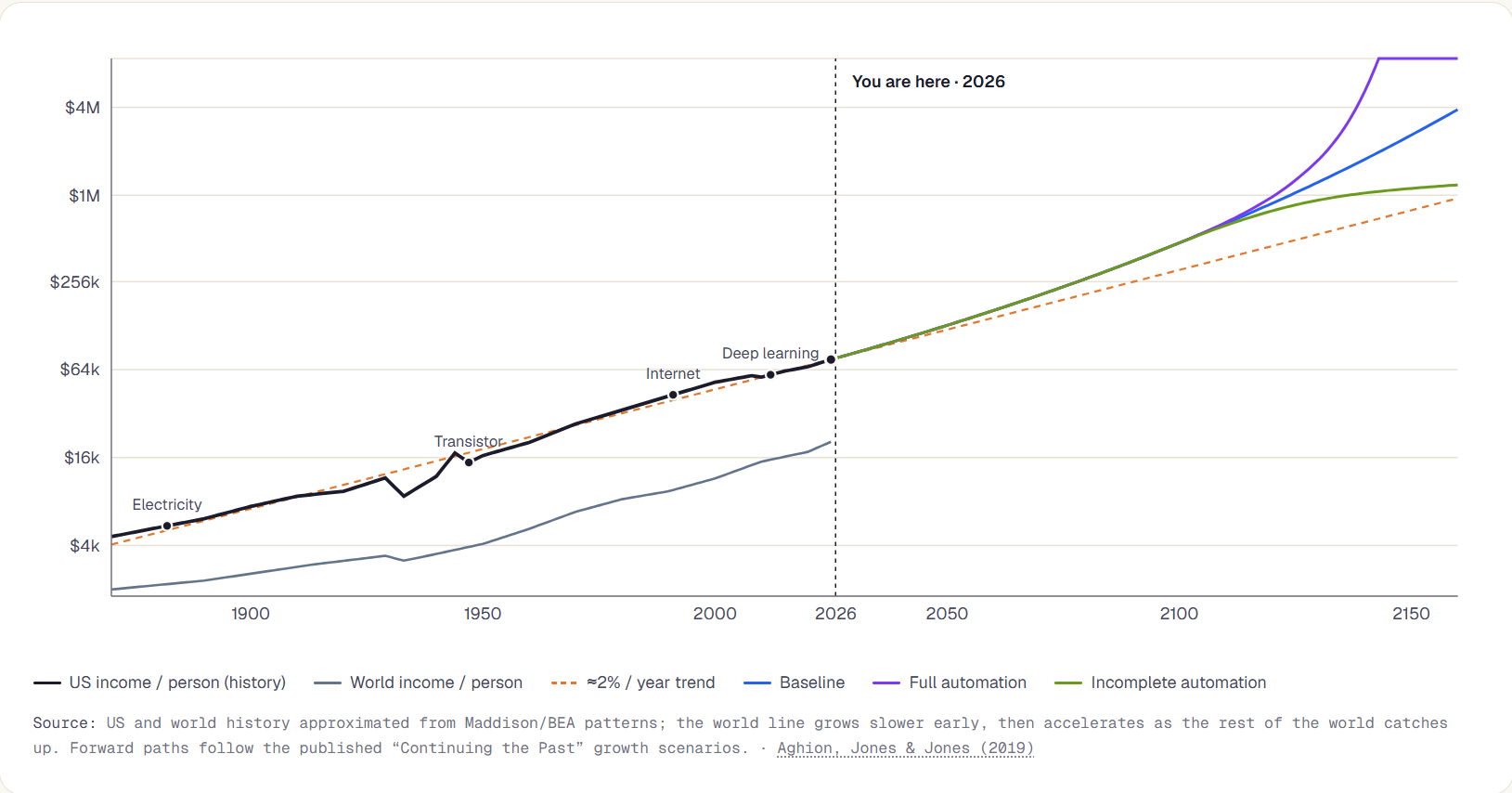
For 150 years, US living standards rose about 2% per year. Not through nothing: through electricity, the internal combustion engine, antibiotics, the transistor, semiconductors, and the internet. Every one of those was transformative. And growth never strayed far from 2%.
How can both be true at once? Wildly transformative technologies, and still 2%?
The answer is the counterfactual. Each technology kept 2% growth going for another 50 years as the previous one ran out of steam. The steam engine runs out of steam. Electricity picks up the slack. Then semiconductors. The line stays straight because something new keeps arriving to hold it up.
The pessimist's version of the AI story is simply that AI is the next technology that keeps 2% alive for another 50 years. The optimist's version is that this time the line finally bends. The honest version is that we cannot yet tell which, and the site shows you why.
The chart that flips the worry
Here is my favorite fact on the whole page.
There are roughly 100 million times more transistors in your pocket than the equivalent person had in the 1970s. You are not 100 million times more productive. Neither am I.
Now look at what computers actually earn. The share of US GDP paid out as a return to computing power peaked at about 4.3% in 2000 and has fallen to roughly 3% since, even as chips went everywhere. Price falls faster than quantity rises. The plentiful thing gets cheap. The scarce thing, humans and the weak links they hold, captures the value.
So when you worry that AI will automate everything, hold this next to that fear: abundance drives down the price of whatever is abundant. Scarcity is where the returns go.
There is even a clean formula hiding in the model. Drive one task's cost to zero and you raise total output by only that task's share of the economy. Software is a few percent of GDP, so infinitely cheap software makes us a few percent richer, once. Real growth means automating the next weak link, and the next, and the next.
A slow explosion
So what happens if you take this seriously, calibrate it to history, and run it forward?
The site lets you explore two calibrations and three scenarios. The headline: even the aggressive "Moore's Law everywhere" case, where machines across the whole economy improve 10% a year starting today, takes about 30 years to fully play out. Growth does eventually explode. But the explosion is slow, because you have to automate every weak link before the flywheel really spins.
In the gentler "continuing the past" case, you are about 1.04 times richer than trend by 2050 and 1.38 times by 2100. In the aggressive case you are 3.2 times richer by 2040. Very different worlds in the long run. Strangely hard to tell apart for the next few decades.
So when does AI stop needing you?
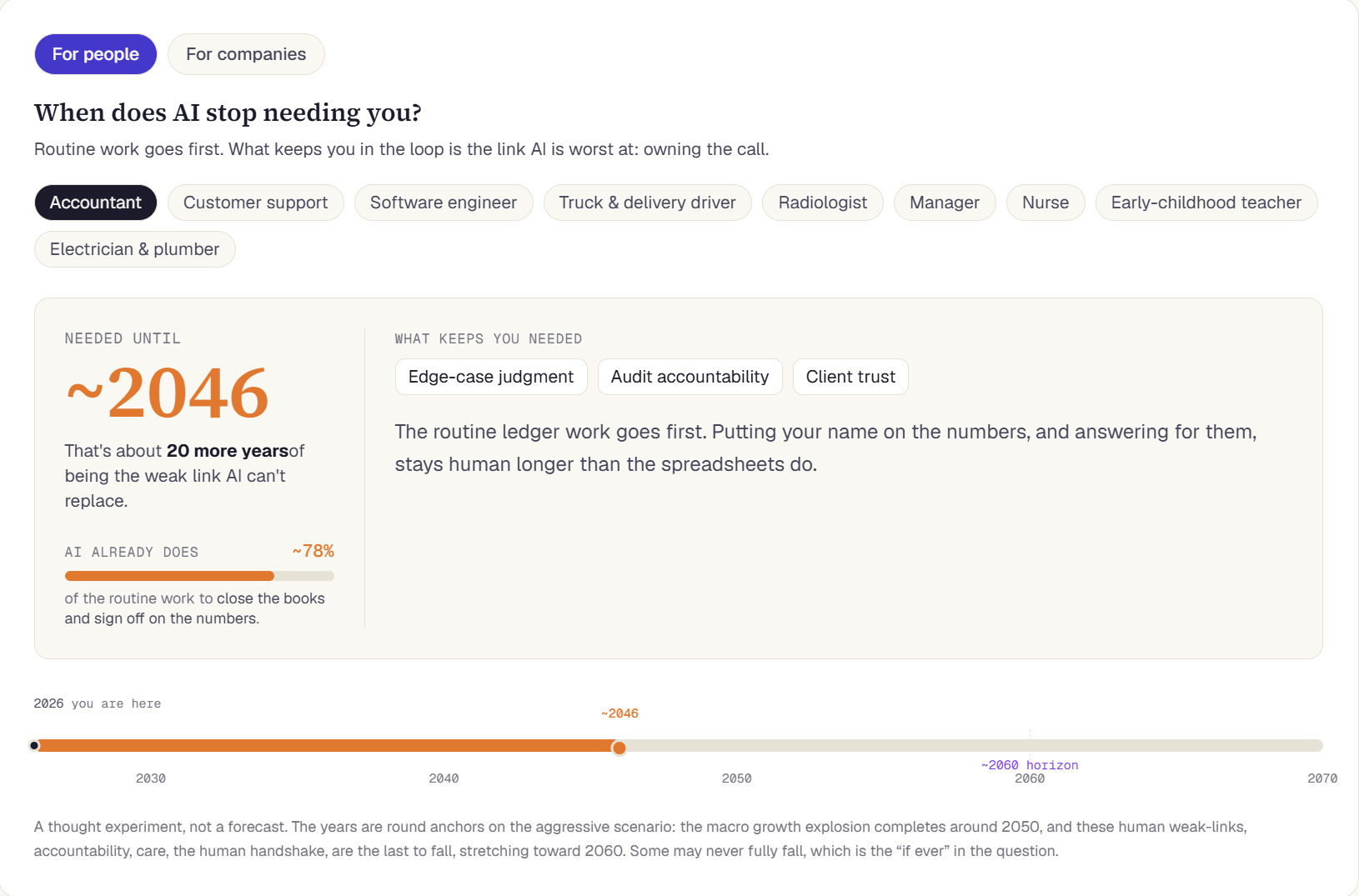
This is the question my friends actually ask, so the site answers it bluntly, with a "safe until" horizon for roles and companies. The rough anchor lands around 2060, with heavy caveats.
The logic is the radiologist. In 2016 a Nobel laureate said we should stop training radiologists because AI would replace them within five years. Instead we have more radiologists now, and they are paid more. Jobs are bundles of tasks. Automate 75 of 100 and the remaining tasks, the weak links, become the scarce, valuable, well-paid part. Sometimes automation grows a field rather than ending it.
Sometimes it does not. If you are betting on Uber drivers in ten years, the weak link is finally falling. The site lets you pick a role and see which links keep you in the loop, and roughly for how long.
The fast downside
Here is the twist that kept me up. The same structure that makes the upside slow makes the downside fast.
Strengthening a chain is slow, link by link. Breaking one link is instant. The Space Shuttle Challenger was lost to a $25 O-ring. A weak-link world is slow to improve and very fragile to break.
So the risks that worry me are not the science-fiction ones first. They are near-term and concrete: a capable model, jailbroken within days of release, pointed at the electric grid or the banking system by someone who should not have it. The site lays these out honestly next to the more speculative concerns, because a map that only shows the upside is not a map.
Who is scarce, and what to do
If cognition becomes abundant, value flows to whatever stays scarce: judgment, accountability, the human-held links, and ownership of the capital. The practical read on the site is short. Be the person who consults the AIs and makes the final call. Own a slice of the capital. Treat redistribution as a deliberate choice, because abundance makes good outcomes possible, not automatic. And find meaning the way retirees do, in a world with plenty to go around.
Built to argue with
I did not want a fan page, so the site steelmans its own critics. The sharpest objection is the one a DeepMind researcher raised at the talk: the whole model assumes the weak links are human and that AI cannot keep climbing at judgment and taste. If that assumption is wrong, the slow story collapses and the upside arrives much sooner. That objection is on the page, in its strongest form, with an honest response.
Every chart carries its source. Every claim carries a status: verified, projection, or claim. The data is a living model, so when the next big release lands, one new entry moves the marker instead of a rewrite.
Go play with it
It is a five minute scroll, and the interactive bits are the point. Open the map, pick a business, break a chain, run a scenario, and find your own weak link.
How many internets is AI worth? Probably many. But it will likely take longer than the headlines promise, and the downside can arrive before the upside. That gap, between the slow real benefit and the fast fragile risk, is the thing worth planning around.
Built on the weak-link view of growth from the economics literature, notably Charles I. Jones, with Daron Acemoglu's work as the skeptical anchor. An independent explainer, not affiliated with any author or institution. I track the curve as the news arrives. Follow along on LinkedIn.