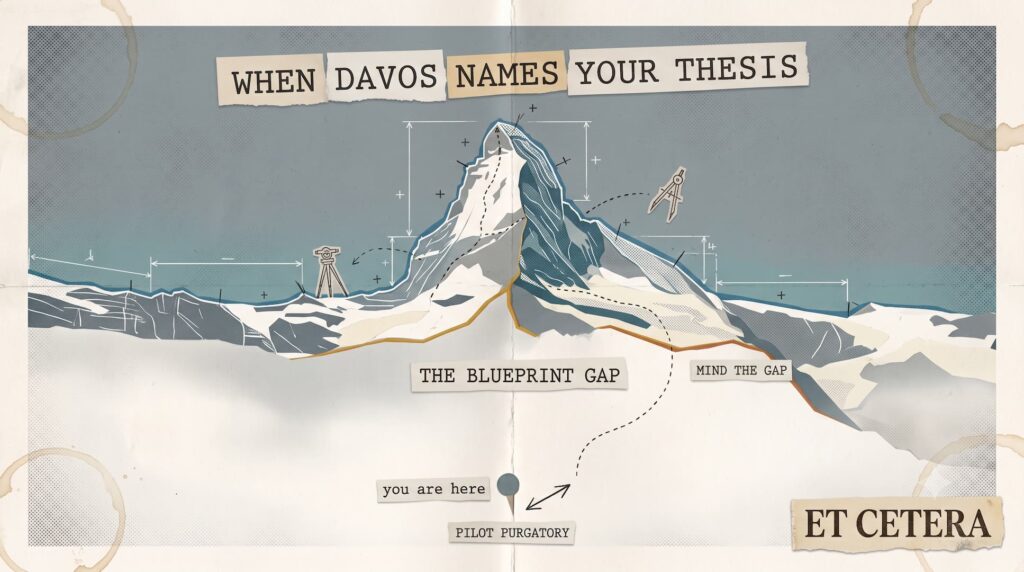
TL;DR: The World Economic Forum and Kearney just published a 51-page blueprint for the "AI-first enterprise." It codifies, with logos and frameworks, a thesis I've been writing here for months. That's the tell: when the most consensus-bound institution on earth prints your edge as a wall poster, the framing is no longer alpha. The value has moved to the one hard part the report describes in a single paragraph and then walks past: the leap from pilots to an operating system. Call it the Blueprint Gap. A blueprint shows you the finished building. It doesn't pour the foundation.
A report landed this month that I want you to read, and then read again for what it doesn't say.
It's the World Economic Forum's The AI-First Operating System: A Blueprint for Operating and Business Model Innovation, written with Kearney, drawn from more than 50 of the most advanced AI companies on the planet. It is genuinely good. The frameworks are clean. The case studies have real names attached. If you want the establishment articulation of where enterprise AI is going, this is now the canonical document.
Here's the strange part. Reading it felt like reading my own outline.
The report's core claim is that winning with AI is not about adopting a tool, it's about redesigning work so the work itself becomes legible to the engine. That's The Legibility Gap almost word for word: AI stalls wherever the workflow was built for human workaround instead of machine participation. Its "AI automates, assists, or stays out" agency scale, allocating intelligence task by task, is The Radiologist Rule: AI eats tasks, not jobs, and the human tasks left over tend to get more valuable. Its admission that the cost base is now variable and metered is the Token Trap and The SaaS Reflex: the zero-marginal-cost instincts you inherited from SaaS stop being true the moment every action fires a GPU. And its warning that you only learn how much tacit knowledge mattered "when AI breaks" is The Fragility Asymmetry: capability that took years to build can fail in an afternoon.
I'm not telling you this to take a victory lap. I'm telling you because the moment your thesis shows up in a Davos publication, its job changes. It stops being a contrarian bet and becomes table stakes. And the interesting question flips from "is this right?" to "if everyone now agrees, where did the hard part go?"
The Consensus Tell
The World Economic Forum is the slowest-moving signal in business. It is built to ratify consensus, not to find edges. That's not an insult, it's its function. By the time a thesis is clean enough for a WEF blueprint, the frontier firms have already lived it for two or three years.
So when the report says the structural limits are gone and the AI-first operating model is the future, treat that the way you'd treat your most cautious board member finally agreeing with you. It's confirmation that the direction is real. It is also a flare telling you the easy advantage, just understanding the direction, is spent. Everyone who reads this report now "knows" the same thing.
That's usually where the actual money starts. Consensus on the destination raises the value of knowing the route. And the report, to its credit, accidentally tells you exactly where the route gets hard. You just have to read the paragraph it tries to move past quickly.
The Blueprint Gap
Here's the named concept I want you to carry into your next planning meeting: the Blueprint Gap.
A blueprint specifies what the finished building looks like. It says nothing about how you pour a foundation under an occupied house without the residents moving out.
The report is 51 pages of destination. The intelligence engine, the adaptive stack, the federated org chart, the T-shaped talent tree, the octopus metaphor for distributed intelligence. It is a beautiful rendering of the finished building. The journey from where you actually stand to that building gets exactly one honest paragraph, on page 22:
"Most enterprises today are not yet at the starting line of that journey. They are running pilots, dozens of disconnected experiments that demonstrate local value but never compound."
That sentence is the whole game, and the report says it and keeps walking. Pilots that demonstrate local value but never compound. I'd give that condition a name too: pilot purgatory. It's where almost every enterprise AI program actually lives, and the report's own numbers confirm it. Despite over $250 billion invested globally in 2025, only 25% of companies say AI is having a transformative effect, and 84% have not redesigned a single job around AI. The blueprint is gorgeous. Roughly one company in four has poured any concrete.
The reason this matters: the gap is not a technology problem, which is the one problem the report is equipped to solve. It's an organizational and economic problem, which is the one it mostly assumes away.
Three things the blueprint won't say out loud
A consensus document has to stay optimistic. That's the genre. But if you read it like an operator instead of a delegate, three second-order effects are sitting right there in the text, undercutting the brochure.
1. "Costs don't automatically go down" quietly dissolves the ROI story
The report's headline proof of operational leverage is Gamma, which moved inference gross margin from roughly 31% to 77% in six months. Stunning number. Then, on page 32, the quiet correction: "this does not mean costs automatically go down… companies must manage a new economic equation: the performance gains versus the variable costs of delivering them at scale, including compute, model access, licenses and specialized AI roles."
Read that twice. The entire pitch is "more output from the same base," but the cost base is now variable and metered, and it scales with usage. That is the exact trap I named in The Token Trap and The SaaS Reflex: you inherit a zero-marginal-cost mental model from SaaS and apply it to a business where every action fires a GPU. The report names the risk and then files it under "economics to manage," as if managing it were a footnote rather than the difference between a flywheel and a bonfire.
2. Skill atrophy is a balance-sheet risk wearing an HR costume
Buried in the talent section is the most honest sentence in the document: "Organizations often only discover how critical that tacit knowledge was when AI breaks. Skills can be retrained; judgement is harder to restore."
The report treats this as a coaching note. It's a liability. When you automate the executional middle layer, you stop producing the mid-career judgement that used to come from doing that work. You're not just cutting cost, you're drawing down a reserve of human expertise you didn't put on any balance sheet, and you find out the balance when the system fails. That's the slow-clock face of The Fragility Asymmetry: the capability degrades quietly for years, then the bill arrives all at once, on the afternoon the system breaks and nobody in the room remembers how the work was actually done.
3. The "federated org" is a power struggle drawn as an org chart
The report's recommended structure is a federated model: a central intelligence team owns shared infrastructure, business units own their own budgets and outcomes, and an embedded chief AI officer sits in each unit with dual reporting lines. On a slide, it's elegant. In a real company, dual reporting lines are where careers go to negotiate. "Who owns the P&L impact of a shared model that one unit funded and three units use" is not an architecture question, it's a political one, and it's precisely the kind of question that keeps programs in pilot purgatory. The report shows you the destination org chart. It does not show you the eighteen months of turf war required to get there, the part where "who owns the shared model's P&L" gets settled by whoever has the most organizational gravity, not the cleanest diagram.
A note on reading the receipts
One practitioner habit before you cite this thing in your own deck. Check the footnotes. Several of the most striking figures, the 15x productivity gains, the moonshot timelines, are sourced to "35 AI leader interviews conducted by the World Economic Forum." That's the people being celebrated, describing their own results. It's useful signal, but it's self-reported, not measured. This is exactly the Storyteller Monopoly problem: once plausible stories are cheap, the scarce skill is no longer producing them, it's judging which ones are real, and a polished WEF chart is a very plausible story.
The document is also dated June 2026 and presents some forward-looking product launches as established fact. When you reference the report, attribute the spicy numbers to the report ("WEF reports a 15x gain"), not to reality. Let the fragile claims stay theirs. Your credibility is the asset you're protecting, and the cheapest way to lose it is to launder someone else's optimism as your own measurement.
What actually owns the route
Naming the gap isn't enough, so let me name what closes it. "Sell the route" is a posture until you say what the route is made of, and on this the frontier firms are not subtle: the durable advantage is the compounding loop, not the model sitting on top of it. Your proprietary data. Your evaluation sets. Your codified institutional judgement. Those are the assets that get more valuable every month you operate, and they're the ones the blueprint quietly assumes you already have.
Here's the test that separates a moat from a subscription: if your model vendor doubled its price or shipped a worse version tomorrow, what would still be yours? If the answer is "nothing," you don't own a route, you're renting one. The model should be swappable. The loop underneath it should not be. Your evaluation sets are part of that loop: the instruments that tell you whether a swapped-in model is genuinely better or quietly worse. That is the whole argument of The Narrowing Effect, that speed without instruments is just drift. And the work of making your business legible enough for those instruments to read it is The Legibility Gap: the same effort that lets the engine participate is what builds the one asset a competitor can't buy off the shelf.
And the prize for closing the gap is not only a healthier margin. It's compounding capability your organization owns outright, the kind that turns a one-time productivity bump into a position that widens every quarter. Cost control is the floor. The owned loop is the ceiling. That distinction is the difference between using AI and building something with it.
So, can you use it?
Yes, and more than most. This report is the best free top-of-funnel you'll get all year, because the highest-authority institution in business just validated the direction you're already building toward. The play is not to argue with it. The play is to agree with the destination loudly and then go build the route: the owned, compounding loop that makes the model swappable and the advantage permanent. That's where the unsolved work, and therefore the value, actually lives.
The blueprint is finished. The building is not. Mind the gap.
The Monday Morning Checklist
If you're a founder or CEO:
- [ ] Pick one workflow out of pilot purgatory this quarter. Not ten. One, instrumented end to end so each cycle feeds the next, and so the data, evals, and judgement it produces stay yours.
- [ ] Run the ownership test on your flagship AI bet: if your model vendor doubled its price tomorrow, what would still be yours? If the answer is "nothing," you're renting a route, not building one.
- [ ] Put the variable cost of intelligence (compute, model access, AI roles) on the same slide as the productivity gain. If they're not on one slide, you don't have a business case, you have a demo.
If you run a function (CIO, COO, business unit lead):
- [ ] Name the handoff that kills your best pilot. The report is right that friction lives at the seams between teams. Fix the seam before you buy another tool.
- [ ] Before you automate a task, ask what judgement that task currently produces, and where that judgement will come from once nobody does the task.
If you're an operator or senior IC:
- [ ] Read the report's page 22 and page 32, not the executive summary. The honesty is in the qualifiers.
- [ ] When you quote the report, quote it as the report. Keep the self-reported numbers labeled as claims.
Sources: World Economic Forum & Kearney, The AI-First Operating System: A Blueprint for Operating and Business Model Innovation (June 2026). Related reading: The Token Trap · The Legibility Gap · The Narrowing Effect · The Storyteller Monopoly