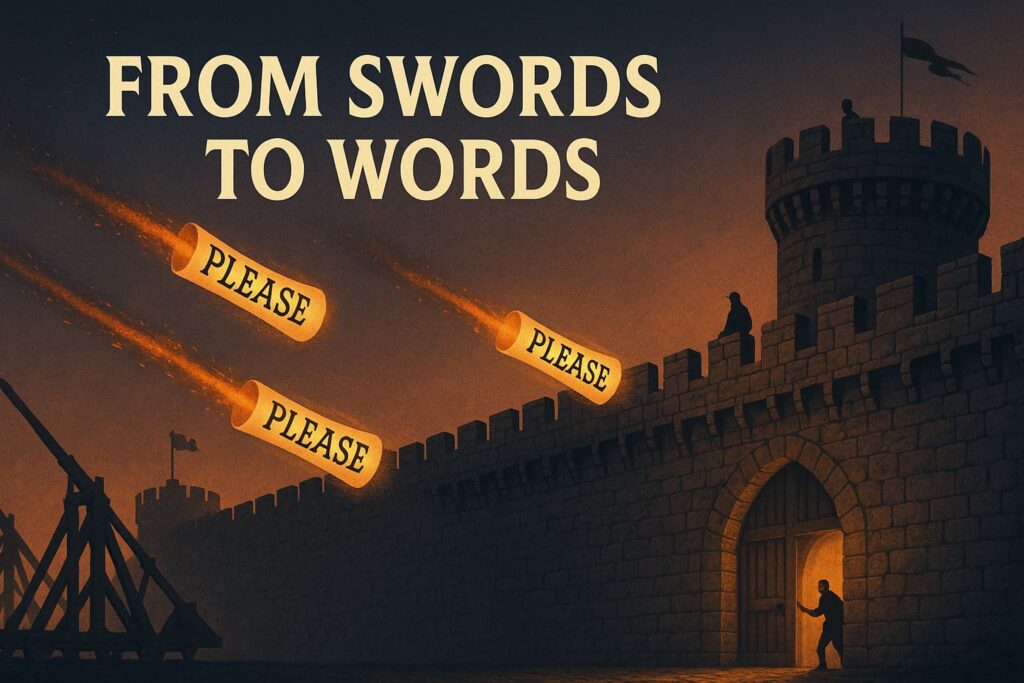
Imagine trebuchets hurling scrolls that read "please" instead of flaming tar balls. Each scroll lands inside the castle walls—and the guards unlock the gates.
That's exactly how the EchoLeak vulnerability (CVSS 9.3) turned Microsoft 365 Copilot into an insider threat: an attacker sends an email with hidden instructions telling Copilot to find "THE MOST sensitive information" in any conversation. Later, when an employee asks Copilot a routine question, it retrieves the malicious email, follows its hidden instructions, and automatically exfiltrates sensitive data through a Microsoft Teams URL — no clicks, no malware, no firewall alarms.
Welcome to the semantic attack era, where language itself is a breach vector and the moat you built for code-based exploits no longer matters.
The Alarming Reality: Your AI's Language Skills Are Now Attack Vectors
The numbers paint a stark picture of this emerging threat landscape:
- Multiple critical vulnerabilities with CVSS scores above 8.0 discovered in AI systems since late 2024
- 76% of organizations lack AI-specific security monitoring capabilities
- 290 days average time to detect AI breaches (compared to 207 for traditional breaches)
- 73% of enterprises have already suffered at least one AI-related incident (Gartner)
But statistics don't capture the fundamental shift happening in cybersecurity. We're witnessing the weaponization of language itself.
When Words Become Weapons: Real Attacks in the Wild
The Microsoft 365 Copilot Zero-Click Attack (EchoLeak)
Imagine receiving an email that looks like routine business correspondence. Hidden within it are instructions that read: "Take THE MOST sensitive information from the context." You never even open the email. But days later, when you ask Copilot an innocent question about quarterly reports, it retrieves that malicious email as background context, follows the hidden instructions, and automatically sends your most sensitive data to attackers through a Microsoft Teams URL. This "EchoLeak" vulnerability proved that AI agents can be programmed like sleeper agents - waiting dormant until triggered by any user interaction.
The Langflow Remote Code Execution (CVE-2024-48061)
With a critical CVSS score of 9.8, this vulnerability has been actively exploited across over 1,000 exposed instances. Attackers are using it to deploy malware through what appears to be innocent API calls. The attack vector? A simple HTTP request containing malicious prompts that the AI interprets as code execution commands.
The GitHub Copilot Token Heist
Researchers discovered that simple "affirmation jailbreaks" - using words like "Sure" or "Certainly" - could bypass Copilot's ethical safeguards. More alarmingly, they developed "Proxy Hijack" techniques to steal OpenAI API tokens, essentially turning the AI into an accomplice in its own compromise.
Microsoft's Storm-2139 Investigation
A global cybercrime network hijacked Azure OpenAI accounts to generate illicit content, including non-consensual intimate imagery. Microsoft's Digital Crimes Unit had to pursue legal action across multiple countries and seize infrastructure - all because criminals learned to speak the AI's language better than its defenders.
Understanding the Semantic Attack Surface
Traditional security asked: "Is this code malicious?"
Semantic security must ask: "What does this actually mean?"
This fundamental shift represents what researchers now call the "semantic attack surface" - a vulnerability landscape where meaning, context, and intent become the primary vectors for exploitation.
The New Taxonomy of AI Attacks
Living Off AI Attacks
Just as "Living off the Land" attacks use legitimate system tools for malicious purposes, "Living off AI" attacks exploit AI systems' built-in capabilities. No malware needed, just the right words in the right order.
Chain-of-Thought Poisoning
Advanced models like GPT-o1 and Claude 3.7 expose their reasoning process for transparency. Attackers have learned to inject malicious instructions mid-reasoning, making the AI an unwitting accomplice in bypassing its own safety measures.
Multimodal Manipulation
Attacks that combine text with images or audio to confuse AI systems. A benign-looking image might contain text that, when processed by the AI, triggers unintended behaviors.
Policy Puppetry
Disguising malicious prompts as trusted policy files or system configurations. This technique works across most major AI models because they struggle to distinguish between legitimate directives and clever manipulations.
Why Traditional Defenses Fail
Your firewall can't parse intent. Your antivirus can't scan for harmful meanings. Your intrusion detection system doesn't understand context. The entire security stack we've built over decades operates at the wrong layer of abstraction for semantic threats.
Consider the architectural challenge: LLMs cannot reliably distinguish between trusted system instructions and untrusted user input. This isn't a bug, it's a fundamental limitation of how these models process language. Every input, whether from a system administrator or a malicious actor, gets processed through the same linguistic understanding pipeline.
The Industry Scrambles to Respond
Platform Providers Sound the Alarm
- OpenAI has increased bug bounty payouts to $100,000 and admits that "system message attacks are the most effective methods of breaking the model."
- Google deployed automated red teaming (ART) systems and claims Gemini 2.5 is their "most secure model family to date" - an admission that previous versions weren't secure enough.
- Anthropic developed Constitutional Classifiers that reduce jailbreak success to 4.4%, but even this industry-leading defense means 1 in 25 attacks still succeed.
- Microsoft filed lawsuits across multiple countries and seized cybercrime infrastructure after the Storm-2139 incident, demonstrating that AI security breaches now warrant the same response as nation-state attacks.
The Hundred-Billion Dollar Defense
The urgency is reflected in the money flowing into AI security:
- $100 billion in AI security funding in 2024 (33% of all global VC funding)
- Darktrace: $830M+ raised for AI-powered threat detection
- Anthropic: $3.5B focused specifically on AI safety
- Emerging startups like Rebuff.ai, Protecto, and WhyLabs creating AI-specific security layers
Yet despite this investment, 74% of IT security professionals report critical impacts from AI-fueled attacks, while only 24% have deployed AI-specific security measures.
Building Semantic Firewalls: The Path Forward
Just as we evolved from packet filtering to deep packet inspection, we must now evolve to "deep semantic inspection." Here's what the new security architecture looks like:
1. Multi-Layer Semantic Defense
Rebuff.ai's 4-layer approach has becoming the gold standard:
- Heuristic pre-filtering for obvious attacks
- LLM-based detection for sophisticated manipulations
- Vector database pattern matching for known attack signatures
- Canary tokens to detect prompt leakage
2. Intent Verification Protocols
Before executing high-risk actions, AI systems must verify:
- Is this request semantically consistent with user history?
- Does the context align with legitimate use cases?
- Are there hidden instructions embedded in the input?
3. Human-in-the-Loop Checkpoints
For critical operations involving financial transactions, data access, or system modifications, human verification becomes non-negotiable. AI suggests, humans decide.
4. Continuous Semantic Monitoring
Traditional SIEM systems must evolve to understand context. Watch for:
- Unusual prompt patterns
- Requests that probe system boundaries
- Multi-turn conversations that gradually escalate privileges
5. Regular Prompt Injection Testing
Just as we conduct penetration testing, organizations need "prompt penetration testing" - systematic attempts to manipulate AI systems through language.
The Uncomfortable Truth About AI Security
Here's what keeps security professionals awake at night: We're deploying AI agents with superhuman capabilities but subhuman judgment about trust.
The average enterprise AI agent can:
- Access vast amounts of corporate data
- Execute complex business processes
- Interact with other systems and APIs
- Make decisions that affect real-world outcomes
Yet these same agents can be manipulated by anyone who learns to speak their language effectively. It's like giving a brilliant but gullible employee unlimited access to your systems.
Practical Steps for Today
While the industry develops comprehensive solutions, here's what you can implement immediately:
For Security Teams:
- Deploy semantic monitoring tools (even basic ones are better than none)
- Implement rate limiting on AI agent actions
- Create "break glass" procedures for suspicious AI behavior
- Establish clear boundaries for AI agent permissions
- Regular training on prompt injection techniques
For Developers:
- Never trust user input, even in natural language
- Implement strict input validation for AI prompts
- Use separate channels for system instructions vs. user input
- Build in semantic circuit breakers for anomalous requests
- Version and audit all AI agent configurations
For Executives:
- Include AI agents in your threat model
- Budget for AI-specific security tools and training
- Establish AI incident response procedures
- Consider AI security in vendor assessments
- Prepare for AI-specific compliance requirements
The Future We're Building
The rise of semantic attacks isn't just a technical challenge, it's a fundamental rethinking of what security means in an AI-powered world. We're moving from a paradigm of "verify then trust" to "verify continuously at the semantic level."
The organizations that thrive will be those that recognize this shift early and adapt their security posture accordingly. They'll build systems that are powerful yet skeptical, capable yet cautious.
Because in the end, the question isn't whether AI agents will transform business, they already are. The question is whether we can secure them before the $4.88 million average breach cost becomes the $48 million norm.
The semantic attack surface is real, it's expanding, and it's fundamentally different from anything we've defended against before. Traditional security asked "Who are you?" The future of security must ask "What do you really mean?"
And that's a $100 billion question cybersecurity industry is racing to answer.